
Introduction
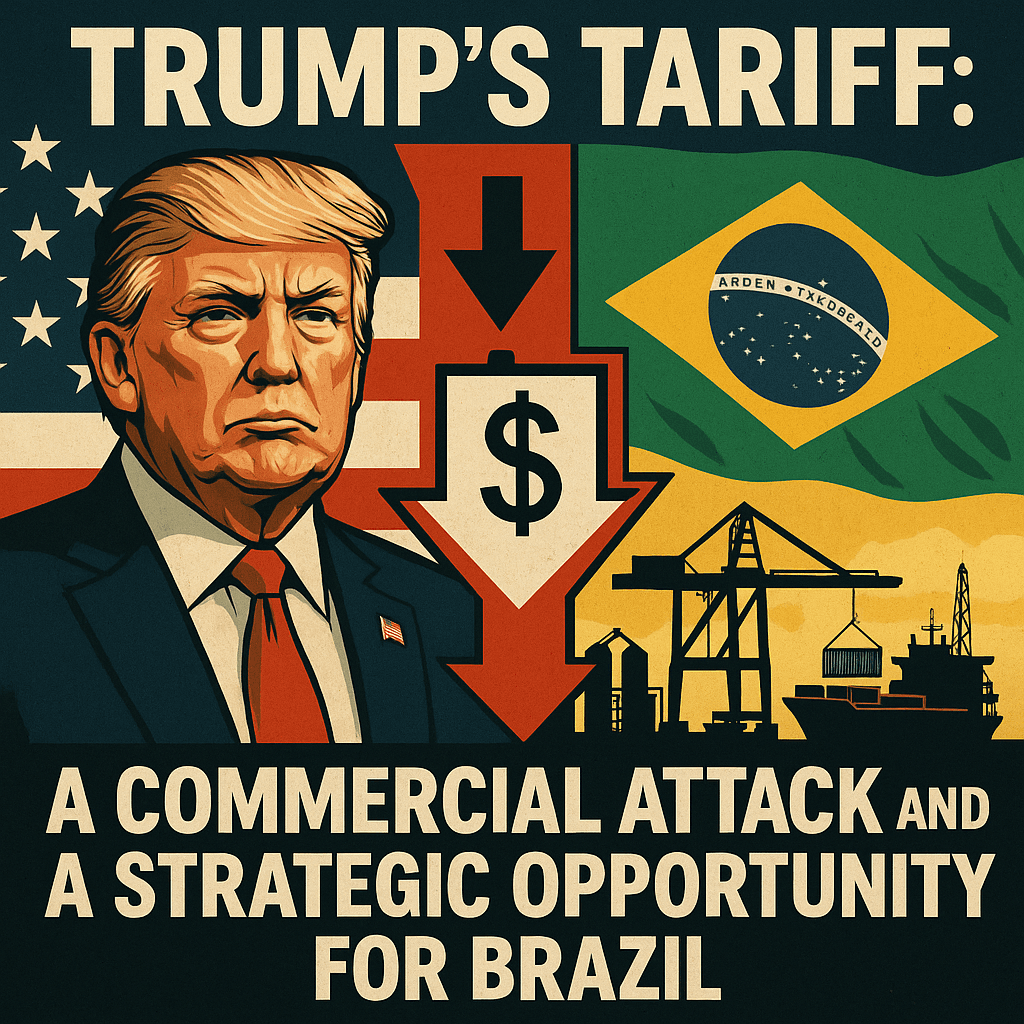
In July 2025, the United States—under President Donald Trump's administration—imposed unprecedented tariffs on key Brazilian exports, including steel, aluminum, and agricultural commodities. While officially framed as an economic maneuver, this decision should be understood as a political gesture of coercion. It reveals a broader transformation in the global order and places Brazil at a critical crossroads.
As Gillian Hart (2023) proposes in her framework of conjunctural analysis, understanding moments like this requires connecting three layers: structure, conjuncture, and event. Structurally, Brazil remains dependent on a narrow set of export markets and primarily sells low value-added goods. The event—the U.S. tariff—is not an isolated disruption, but part of a strategic effort by a major power to reshape trade relations through force rather than rules.
Strategic Vulnerabilities and the Weaponization of Tariffs
The imposition of tariffs by the United States on Brazilian exports must be understood not merely as an economic dispute, but as a deliberate deployment of tariffs as commercial weapons in pursuit of geopolitical and domestic objectives. The international political economy literature demonstrates that tariffs allow powerful countries to economically pressure adversaries, shape domestic and foreign policy decisions, and protect their own strategic interests.
Tariffs as Imperialist Tools
The literature further identifies that when imposed excessively by dominant powers, tariffs can operate as tools of economic imperialism. By restricting the industrialization and development of weaker economies, such practices replicate colonial-era exploitation mechanisms.
In contemporary contexts, the US–China trade war is a clear illustration of the use of tariffs to defend global hegemony and limit a rival's technological ascent. The same logic underpins U.S. tariffs against Brazil: by impeding the growth of Brazilian export sectors, the U.S. not only protects its domestic industries but also entrenches asymmetric dependencies.
A Path Forward: Strategic Response and Historical Opportunity
While the crisis is severe, it also presents a historic opportunity. Brazil can and must design a national strategy of economic security based on four pillars:
1. Market diversification, reducing dependence on U.S. and Chinese markets.
2. Reindustrialization with emphasis on technology, innovation, and regional value chains.
3. Active diplomacy, reclaiming leadership in the Global South and in multilateral institutions.
4. Reinstitutionalization of trade governance, rebuilding agencies like APEX, MDIC, and Itamaraty with a focus on long-term strategic planning.
Conclusion
Two paths lie ahead. One is the continuation of vulnerability and reaction, accepting a subordinate position in the international system. The other is the construction of a sovereign, strategic, and autonomous project of national development and international insertion.
The U.S. tariff is more than an economic aggression—it is a wake-up call. It challenges Brazil to abandon illusions of automatic alignment and instead reclaim its capacity to act with autonomy, forge new alliances, and defend its national interests.
As Rubens Ricupero stated, Brazil must respond "on the same level." Not through retaliation for its own sake, but through the formulation of a coherent, assertive, and visionary strategy of international reinsertion.